





Building with Flint: a practical guide to the use of flint in design and architecture

Building with Flint: a practical guide to the use of flint in design and architecture, David Smith, Crowood Press, 2024, 160 pages, many colour illustrations, paperback.
The subtitle of this useful new book may raise expectations, but these are more than adequately fulfilled. David Smith, an experienced craftsman who has worked with flint for some 40 years, brings his knowledge of the stone, its history and regional variations as background to an exemplary practical guide for designing and building with flint. His career began in conservation, but has expanded to new building with flint, which he promotes passionately.
Smith begins with an understanding of the geology: flints are nodules of silica, found in layers in chalk. The silica is derived from skeletal remains of sea creatures and the shape of flints fills the burrows of these animals. He continues with the history of its use from prehistoric times. Flint has been used by humans in Britain for over 850,000 years. Initially perhaps only for food preparation, it was later used as arrowheads and axes for felling trees and working wood. Later in the neolithic period, vast flint mines were established. The best known of these, Grimes Graves in Norfolk, dating from about 4,000 CE, consists of over 400 pits in an area of 91 acres. These were excavated with galleries, using antlers and flints for digging and sticks to dislodge flints. Worked galleries were backfilled with chalk spoil. It is thought that only rough working of the stone was carried out on site, with the usable flints then traded on to be worked elsewhere.
Flint could also be found as fieldstones and beach pebbles and was used extensively in building from the Roman period onwards and throughout the middle ages, largely in southern and eastern Britain. Smith covers this history simply. He takes a fascinating diversion into the later gunflint industry based at Brandon in Norfolk, which reached its peak during the Napoleonic wars. Flint was mined in small pits, like those at Grimes Graves, and worked by many individual knappers, whose life expectancy averaged 44 years because of silicosis. Flint was also mined from the late 17th century for use in the production of fine china. It was revived as a building material in the 19th century when some of the finest ‘flushwork’ appeared in the restoration of medieval churches. Unusual uses of flint and cobbles appeared in distinctive areas: there is flint and cobbled paving at West Dean incorporating horse teeth, and at Cley-next-the-Sea is an elaborately detailed house with a rather gruesome flint-and-bone cornice.
This book is exceptionally well illustrated. There are delicious examples of the uses of stone in bands and checker patterns from across the UK and northern France. The book is likely to make the reader want to design and build in flint. The second half consists of a guide to planning, buying and working the stone, with clear advice on techniques of laying flints, types of wall construction, and mortar selection and use. None of this is prescriptive, rather the detailed discussions provide information for the specifier to make her or his own decisions.
Modern products such as precast flint blocks and panels, and gabion baskets for walling, are also illustrated and discussed, together with the flint quoins used on the award-winning Flint House at Waddesdon. There is a great variety in the material from field flints, beach pebbles to worked flints, which can be laid randomly or coursed. The appearance of the finished work depends on the type of mortar and pointing techniques, which can often include ‘galletting’. This is the insertion of small flint shards into joints, perhaps for their weathering advantages and certainly creating a distinctive effect. Pushing thousands of sharp flints into mortar joints is hard and uncomfortable work, and in my experience on repair contracts, it was always best to ask gently and politely for this to be done.
This book is a most useful introduction to the history and use of flint in its regional variations, and it is comprehensive in covering the contemporary supply of materials, techniques of construction and methods to match and repair older buildings. It is essential for conservation specialists, craftspeople and anyone tempted to commission or build in flint.
This article originally appeared as ‘From Grimes Graves to galletting’ in the Institute of Historic Building Conservation’s (IHBC’s) Context 180, published in June 2024. It was written by Jane Kennedy, retired architect.
--Institute of Historic Building Conservation
Related articles on Designing Buildings Conservation.
IHBC NewsBlog
IHBC sponsors Gardens Trust event 23-4 Sept 2026
.jpeg)
'Learning from the Past, Shaping the Future’ takes place in Milton Keynes
Renovations to Frank Lloyd Wright's Fallingwater complete
.jpg)
World Heritage Preserved project opens house for tours again
Shakespeare Birthplace Trust places Hall's Croft on HAR Register
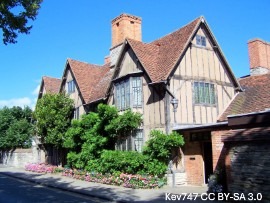
Stratford-upon-Avon home of Shakespeare's daughter is 'At Risk'
Lady Grange’s House repaired on St Kilda
.jpg)
National Trust for Scotland repairs stone cleit with link to famous island resident
Griff Rhys Jones on BBC Radio 4 Today programme
,_Green_Lane,_Derby.jpg)
The Victorian Society’s President unveiled its latest Top Ten Endangered Buildings 2026.
Need a MATE? Book your place now.

IHBC offers free webinars on applying for IHBC accreditation (Full & Associate).
UK Stained Glass Repository finds windows new homes

How are stained glass windows are rescued, stored and repurposed?
APPGEBE report sets high aims for quality
'Government must not sacrifice quality in drive to build 1.5m homes'
New measures protect Historic Shipwrecks from heritage crime

Underwater cultural heritage benefits from new HE guidance
How could the City of London skyline look in 6 years' time?

Visualisation shows approved planning applications as completed buildings
National Trust for Scotland calls for VAT cuts

Heritage neglect is encouraged by current policies
IHBC's 'Context' Issue 186 features Industrial Heritage

IHBC's members' journal reports on the challenges of conserving infrastructure
Book now for IHBC Annual School 2026

IHBC Annual School is taking place 18-20 June 2026 in Newcastle
RICHeS Research Infrastructure offers ‘Full Access Fund Call’
RICHeS offers a ‘Help’ webinar on 11 March
Latest IHBC Issue of Context features Roofing
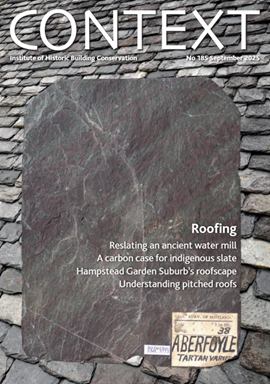
Articles range from slate to pitched roofs, and carbon impact to solar generation to roofscapes
Three reasons not to demolish Edinburgh’s Argyle House

Should 'Edinburgh's ugliest building' be saved?
IHBC’s 2025 Parliamentary Briefing...from Crafts in Crisis to Rubbish Retrofit
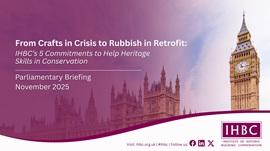
IHBC launches research-led ‘5 Commitments to Help Heritage Skills in Conservation’
How RDSAP 10.2 impacts EPC assessments in traditional buildings

Energy performance certificates (EPCs) tell us how energy efficient our buildings are, but the way these certificates are generated has changed.